After our November
post about the orchard, here is an update of its progress. In the words of John Bunker all you need is new wood, air and sunlight, and the rest is up to you and your tree's individual personality and story.
Two weekends ago we had the very good fortune of hosting a
MOFGA pruning workshop on our homestead, for very old apple trees. John Bunker and Phil Norris were our instructors, about twenty people came, and it was a perfect day with warm sun rays and my very first sights of butterflies.
During this 4 hour course we learned about the best practices of pruning fruit trees (as opposed to pruning for powerlines or ornamentals who just need to look good), to maximize their fruit production, but also to bring back trees that have been left untended for quite sometime.
Being that our house was built circa 1840, we have some Old trees, and although they might look 'old' and dying, they are still kicking. And it is possible to bring them back to interesting fruit production with a little help.
 | |
| Our Russet before... sorry I don't have a better before picture |
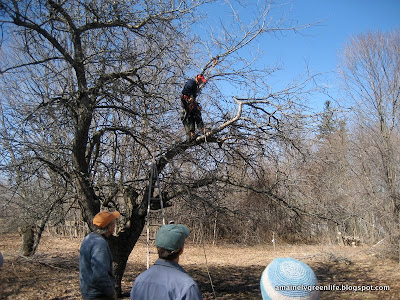 |
| Our Russet being actively pruned :) |
First, you want to assess the vigor of your tree, to determine whether or not it will do well with an intense makeover all at once, or if you could help it with some homemade braces under some branches to reduce the pressure of gravity on the main trunk, or even more important, whether or not the fruit is any good! Have you tried it? Lots of different apples can be used for different purposes -- fresh eating, sauce, baking, juice, cider, apple butter, animal feed, etc. -- but not all apples are worth all that work. Especially if they are seedling trees (meaning it isn't a grafted apple variety but one that simply grew from a seed). Seedling trees may be edible, but rarely delicious. So the advice given to us was to first try the fruit of the seedling trees we have, and maybe if it's not all that interesting, to use the tree as a root stock to save, or simply multiply one of our other trees with a better fruit on it.
From what I understand, all apple cultivars we commonly know of by name are supposed to be genetically identical specimens
to the original one. That is because they are propagated through grafting or budding, grown from a twig of the original one, passed down from generation to
generation. That is the beauty of orcharding: even if your tree is
old, and you think you might not be able to bring it back to life (because of a hollow trunk or a nasty wound) you can give it new life
by grafting a piece of last year's new wood onto a new root stock, or fifty new root stocks! Well that wasn't the focus of this specific workshop, but I am thankful for that option, as my dearest apple (that we have temporarily named the Ghost apple), is probably close to 150 years old and has a very hollow trunk and because of that, could, might, perhaps not survive that much longer (Gulp!). For that reason Mr. Bunker saved quite a few scions (= new wood twigs) which he will transform into new grafted young and healthy Ghost apples for future generations to enjoy.
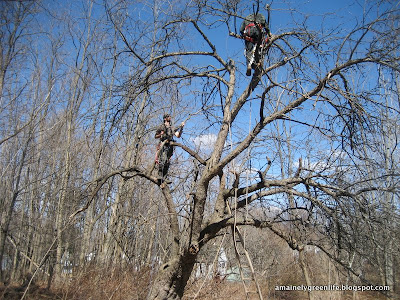 |
| Alex learning the ropes on the ghost apple tree from Phil |
The next thing you can think about when pruning, is pruning the other trees around your apples :) Do you have lots of Norway maples or other early pioneers or invasives slowly taking over your orchard? Cut them back, and use them as lumber, firewood, woodchips, etc, and give more sun to your fruits!
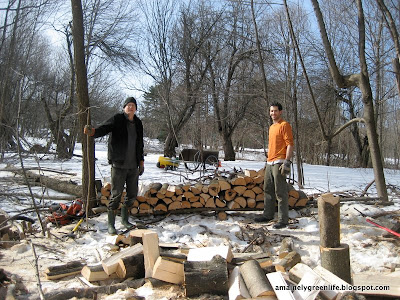 |
| Alex and Ian, cording a Norway Maple that we took down to make room for the Ghost Apple |
Then dead wood is the easiest next step. Remove all the dead branches, to give you a better, more accurate idea of what you will want to keep. Then begin to remove what are called the Water Sprouts, the vigorous vertical branches that shoot straight up.
Apple trees will never have fruits on vertical wood, never. You need to have horizontal growth (or also otherwise called weak wood) to have fruits. So if you see some younger vibrant growth shooting straight up, it might be a good sign that your tree is still very much alive, but you can go ahead and cut it off (remember it might seem extreme, but its not all for not, as you can also then remove last years growth on that branch to make scions :)).
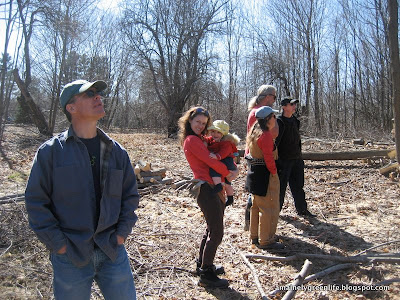 |
| Sabrina came down for the workshop, and Léo in her arms :) |
After removing adjacent trees, dead wood and water sprouts (thus taking care in part of the wood and sunlight aspects), we still have to keep cutting to create AIR. You don't want any of your branches to touch, intertwine, or 'choke' one another. So just like at the hairdresser, you want to layer the tree, and the analogy of a Christmas tree shape was used a lot, even though, with these olds gals, it might have to take a less symmetrical shape :) Obviously you want to encourage growth closer to the ground so you don't have to climb so high to get your fruit, so keep that in mind when you select the branches you will keep. An old adage is you want to cut enough
to be able to throw a cat through the tree!
All cuts should be made directly next to a joint to allow the tree to cover the wound with bark. The two types of pruning cuts, heading and thinning are used for different purposes, but about 98% of all cuts we were told should be thinning cuts (cuts at a branching joint and not somewhere along a branch).
And I guess lastly, take your time, whether you are pruning for the first time or if you are an experienced apple orchardist... As you open up new sunlight areas your tree might be telling you a different story next year, so think of the future, and don't be afraid to be gentle, there is always next year, or the fall. With these older trees, don't be afraid to take your time, do the
pruning in seasons, wait to see if new growth appears right on the trunk
(as it will when you cut some of the top, thereby freeing some sunlight).
I say this because there is a saying, ''When you think you are done pruning, keep pruning!''.
If you know some important tips about pruning, old or young trees, if you have comments, questions or stories about how you prune your trees, we'd love to hear from you :)
Til next time, be well!


